DISRESPECTED AND KICKED OUT OF A LUXURY HOTEL, AMERICAN LEGEND KEITH RICHARDS CAME BACK THE NEXT DAY — NOT TO COMPLAIN, BUT TO…
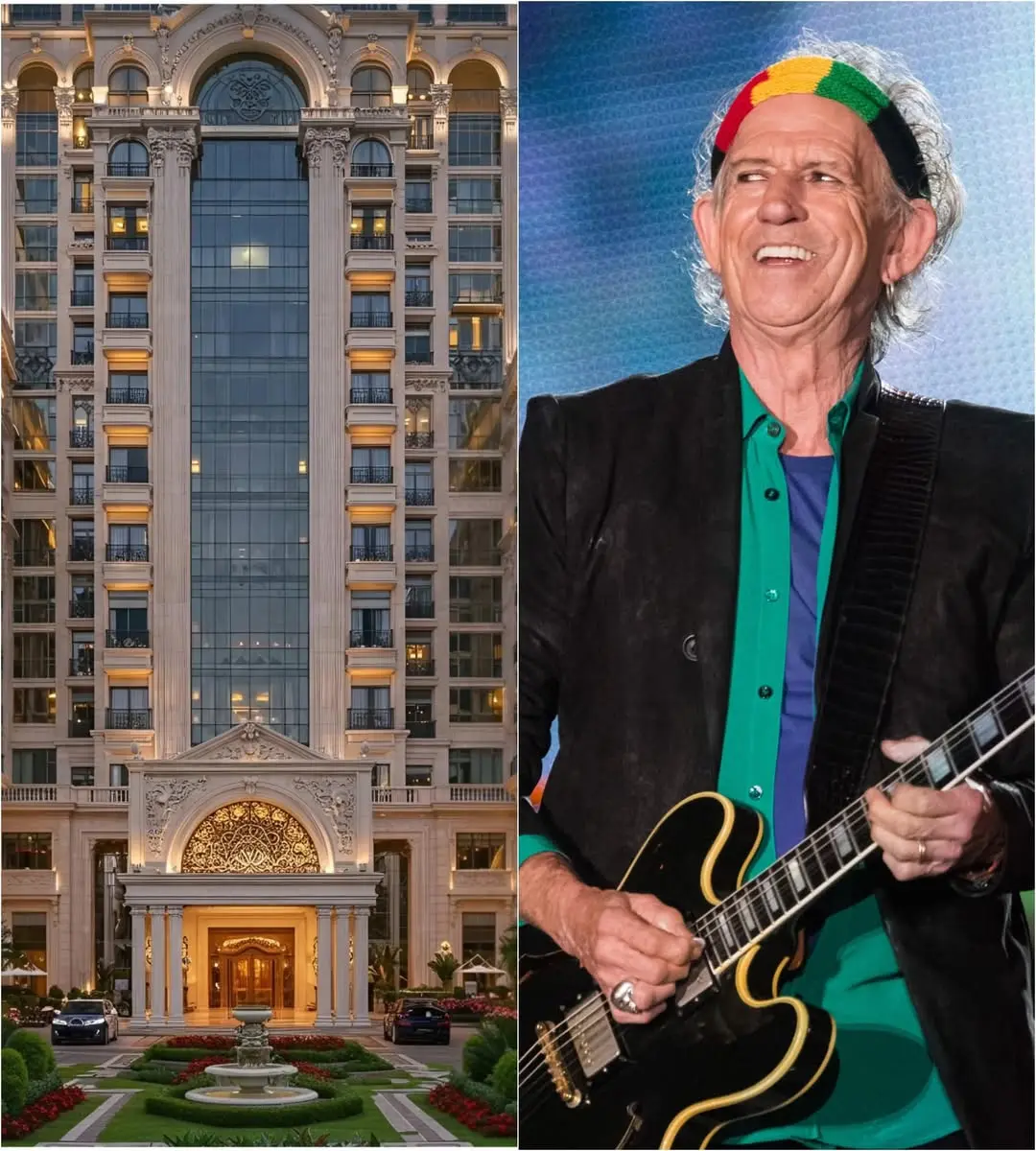
The story broke the way modern legends do—fast, breathless, and impossible to ignore.
A luxury hotel in California. Marble floors. Polished brass. A lobby designed to make people feel small unless they belong. According to accounts that spread like wildfire overnight, staff at the hotel made a decision they would come to regret: they turned away Keith Richards.
Not because of noise.
Not because of behavior.
But because of assumption.
Witnesses say Richards arrived quietly, dressed down, travel-worn, asking for a room like any other guest. No entourage. No name-dropping. Just a man with a weathered face and a calm voice. Staff reportedly hesitated, exchanged looks, and then declined him—questioning whether he “fit” the establishment’s standards.
An American legend, dismissed at the door.
The irony was brutal. Keith Richards is not just a rock star. He is history. Six decades of music carved into the backbone of culture. Songs that outlived presidents, trends, and entire industries. A man whose guitar riffs helped define freedom itself—told, in effect, you don’t belong here.
Richards didn’t argue.
He didn’t raise his voice.
He didn’t demand a manager.
He didn’t remind anyone who he was.
He simply turned around and walked out.
For most people, that would have been the end of it—a bitter story told to friends, another reminder that power often mistakes silence for weakness.
But this is where the story takes its turn.
Exactly twenty-four hours later, Keith Richards returned.
Same hotel. Same glass doors. Same lobby that had looked through him the day before.
This time, he wasn’t carrying luggage.

He walked in wearing a tailored black jacket, posture relaxed, expression unreadable. Those who were there say the room changed instantly—not because people recognized him, but because authority has a gravity of its own. Conversations stopped. Heads turned. Even the air seemed to tighten.
Richards approached the front desk calmly and requested to see management.
What followed, according to the story now ricocheting across the internet, felt less like confrontation and more like reckoning.
He didn’t shout.
He didn’t accuse.
He didn’t relive the humiliation.
Instead, he placed documents on the counter.
Ownership papers.
The claim—now immortalized in headlines and retellings—was staggering: Keith Richards had acquired the hotel. Quietly. Completely. The same place that had turned him away now belonged to him.
Staff stood frozen.
And then came the sentence that sealed the moment into legend.
“I don’t hold grudges,” Richards reportedly said, his voice low and even.
“I rebuild.”
No threat. No triumph. Just control.
Whether taken as literal truth or symbolic parable, the story detonated because it struck something deeper than celebrity revenge. It spoke to restraint. To power that doesn’t need to perform. To a man who has spent a lifetime being underestimated—and outlasting it every time.
Social media erupted.
Some called it the ultimate comeback.
Others framed it as a masterclass in dignity.
Many saw it as poetic justice in an age obsessed with public humiliation.
“This is how real power moves,” one viral post read. “Quiet. Decisive. Unapologetic.”
Critics were quick to question the logistics. Fact-checkers raised eyebrows. Industry insiders urged caution. But none of that slowed the momentum. Because the story wasn’t spreading on paperwork—it was spreading on meaning.
Keith Richards has always occupied a space beyond ordinary metrics. He survived eras designed to consume people like him. He watched peers fall, scenes collapse, rules change. And through it all, he learned something that fame alone never teaches: silence can be louder than outrage.
In the retellings, the focus isn’t on the hotel anymore. It’s on the lesson.

You don’t have to explain yourself to people who underestimate you.
You don’t have to beg for access to places that don’t recognize your worth.
Sometimes the most devastating response is growth so complete it changes the room forever.
Whether the hotel truly changed hands or the story functions as modern folklore, its endurance says everything. People are hungry for narratives where grace beats cruelty. Where composure outshines ego. Where resilience doesn’t scream—it waits.
Keith Richards, real or mythologized in this moment, becomes a symbol again. Not of rebellion this time, but of something rarer: quiet dominance.
In a world addicted to outrage, the idea of a man returning not to complain, but to own the situation entirely, feels almost radical.
And maybe that’s why the story refuses to fade.
Because legends aren’t always built on what can be proven.
Sometimes they’re built on what feels true.
A man walks out humiliated.
Returns unchanged—but everything else is.
No grudge.
No spectacle.
Just rebuilding.
And the world, once again, watches Keith Richards stand exactly where he wants to be—unmoved, unbroken, and unmistakably in control.